lexindex
Compact, immutable string↔id indexes for huge catalogs — a Rust core built on
fst (finite-state transducer) and an in-crate minimal perfect hash,
with typed Python bindings and no Python runtime dependencies.
Build once over a set of strings (entity names, cluster labels, vocabulary terms, document keys),
then query many times: exact string ↔ id both ways, plus prefix, range, fuzzy
(Levenshtein) and subsequence iteration — all automaton-driven over the FST (exact, prefix and
range seek directly; a broad fuzzy or subsequence pattern may still traverse most of the automaton).
The blobs are tiny — on real dictionary words, CompactHashIndex reaches 1.24 bytes/key, 2.4× below
marisa-trie, and StringIndex 5.95 — and all but ClosedHashIndex can be memory-mapped and
borrowed rather than read, DictIndex materialising only its per-block samples and a few
tables, so a multi-gigabyte index is ready instantly and its pages are shared across processes.
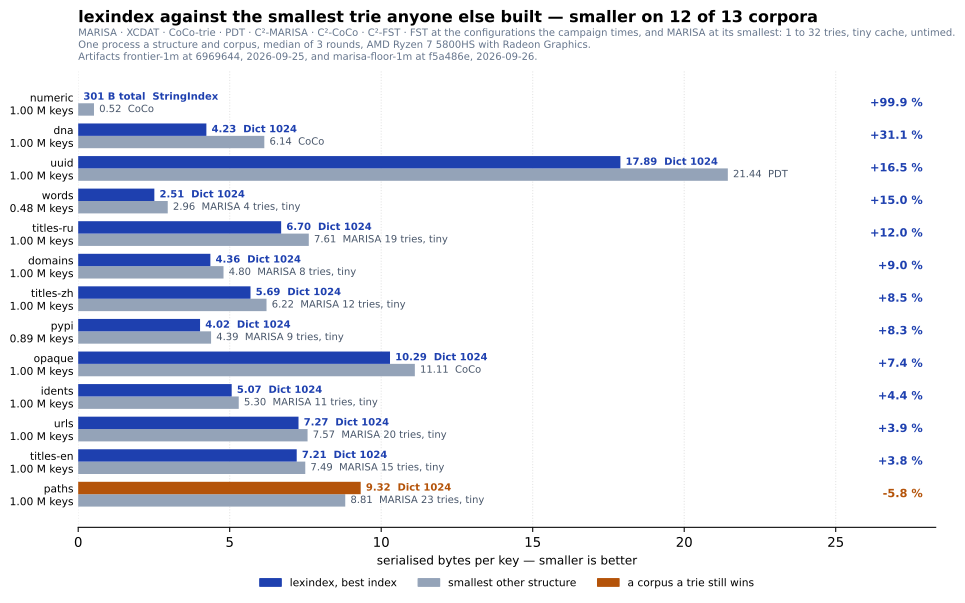
Thirteen corpora at a million keys against MARISA, XCDAT, CoCo-trie, PDT and the C² benchmark's
structures at the configurations the campaign times, and MARISA at its smallest — 1 to 32 tries
under the tiny cache, untimed — which is 5.8 % smaller than DictIndex on paths. The protocol,
the ten-million-key table and every other structure are in
the benchmarks. The figure is the size axis:
lexindex's smallest index wins it on twelve of the thirteen by file, and a mapped DictIndex also
holds the 0.02–0.33 bytes a key of tables it derives at load,
counted beside MARISA's. On an exact lookup XCDAT is still ahead on most corpora at a
million keys: lexindex's fastest exact search there — DictIndex after 4.4's opt-in
route_microblocks(), which holds 0.25–0.5 bytes a key more in memory, StringIndex, or 4.5's
DoubleArrayIndex where its trie is small — beats XCDAT 15 on numeric, words and dna, trails
it by 4–11 % on urls, uuid, paths and titles-ru and by 1.2× to 1.6× on the other six. At ten
million keys it is ahead on dna, numeric and urls, level on titles-en and uuid, and 1.36×
behind on opaque. HashedDictIndex (4.1) wins the latency axis outright: the same dictionary
with its id answered by a perfect hash is 3.8× to 9.0× faster than XCDAT 15 and 1.4× to 3.2×
smaller, on all thirteen corpora at a million keys and all six at ten million — and 2.8× to 7.4×
faster and 1.2× to 2.8× smaller with an 8-bit fingerprint that turns away all but one stranger in
256; an exact answer for a stranger is the dictionary's search above. Every column is in
the benchmarks, and none is quoted here without the
others.
import lexindex

idx = lexindex.StringIndex(["apple", "apricot", "banana"])
idx.id("banana")          # 2   — string → id (sorted rank)
idx.key(0)                # "apple"  — id → string
idx.prefix("ap")          # [("apple", 0), ("apricot", 1)]
idx.fuzzy("aple", 1)      # [("apple", 0)]  — typo-tolerant

idx.save("catalog.bix")
idx = lexindex.StringIndex.load_mmap("catalog.bix")   # zero-copy: no read into RAM
Seven indexes
StringIndex— an ordered index backed by a finite-state transducer. Exactstring ↔ idplus prefix / range / fuzzy / subsequence iteration. The only one that answers typo-tolerant queries. Use it for autocomplete, fuzzy search and ordered browse. For an exactstring ↔ idand nothing else,HashedDictIndexis faster andDictIndexsmaller; for matching a lexicon against text,DoubleArrayIndexis faster.DictIndex— an ordered dictionary with the key stored for every id: exactstring ↔ rankboth ways,lower_bound,prefix,range, in-order iteration, no automata so no fuzzy. The sorted keys are front-coded in blocks, the suffixes coded per shard under a symbol table or a packed alphabet, over a phrase dictionary mined from the whole blob: 2.64 bytes/key, 56 % belowStringIndex. Use it where the queries are exact and every id has to map back to its key.HashedDictIndex— aDictIndexwith a hash sidecar: the dictionary's ranks and ordered queries, withidanswered by a minimal perfect hash and a table of ranks instead of a search. 2.62 bytes/key on top of the dictionary, one more per eight fingerprint bits foridto reject a non-member at2^-bits; at zero bitsidis the dictionary's exact search andid_uncheckedthe closed-vocabulary path — 3.8–9.0× faster than XCDAT, the fastest trie measured, at 1.4–3.2× less space. Use it where aDictIndexis wanted andidis the hot path.CompactHashIndex— the smalleststring → dense idmap that can reject a non-member (a minimal perfect hash plus a fingerprint per key, no keys stored). 1.24 bytes/key, at the cost of probabilistic membership and no reverse lookup. Use it when a fixed vocabulary's footprint is paramount.ClosedHashIndex— the perfect hash and nothing else:id(key) -> u32, noOption, for a vocabulary known to be closed. A member's id, and for anything else some id in[0, n). 0.24 bytes/key, a fifth ofCompactHashIndex. Use it as a token → id map where every query is a member by construction.PerfectHashIndex— a minimal-perfect-hash dictionary with verified membership and reverse lookup; exactstring → dense id, andid_uncheckedis the fastest lookup here for a vocabulary known to be closed. Use it as a fixed-vocabulary token↔id map on a hot path when you need exact membership andid → key. Built withfingerprints=True, one more byte per key lets a lookup of an absent key stop after one cache miss instead of two.DoubleArrayIndex— a character-wise double-array trie for matching a lexicon against running text: the keys a text starts with, the longest of them, and every key occurring anywhere in it, one load a character: the fastest walk measured over Chinese text, at 15.62 bytes a word on jieba's lexicon, below every double array measured there. The ids areStringIndex's ranks, and there is no reverse lookup. Use it for dictionary segmentation, gazetteer tagging and a tokenizer's longest match.
All seven assign dense ids in [0, n) and serialise to a flat, relocatable blob
(save / load, and load_mmap where there is more than the perfect hash to map). None is mutable after building — they are immutable summaries, like
the clustering features in the companion betula-cluster
crate.
What's here
- Usage guide — every interface with runnable Python, Rust and C snippets.
- Design — how the FST rank-walk, the fingerprint and minimal-perfect-hash dictionaries, and zero-copy memory-mapping work, and the serialised blob layout.
- API reference — the typed public surface.
- Upgrading to 4.0 — which 3.x blobs still load, which have to be rebuilt, how to get the keys back out of one, and whose ids survive the rebuild.
- Changelog.
- Sponsor — if lexindex saves memory or latency in a system you run; corporate sponsorship funds compatibility, benchmarking, security hardening and large-scale performance work.